

One of the main concerns in the changing environment of clinical research is the need to keep quality and compliance at the same level. Every deviation, non-compliance, or protocol violation is, therefore, a potential threat to the safety of patients and the integrity of data.
In order to deal with these difficulties, all CRO have made use of a well-organized Corrective and Preventive Action (CAPA) system. CAPA is instrumental in finding the causes of the problems, fixing the issues that exist, as well as stopping the problems from recurring – thus, clinical trial operations and regulatory readiness get improved.
This blog sheds light on what CAPA means in clinical trials, the CAPA process in clinical research, and the best practices every CRO follows to maintain global quality compliance.
CAPA, Corrective Action and Preventive Action, is a quality management system that involves a detailed quality process of recognition, investigation, rectification, and prevention of issues in clinical research operations. Besides, it is a necessary constituent of Clinical Quality Management Systems (CQMS) and constitutes the core of compliance programs under the FDA, EMA, and ICH-GCP regulatory frameworks.
Basically involves finding the root cause of the non-conformities and then removing it. Non-conformities may include things like protocol deviations, data inconsistencies, or audit findings.
Is about preventing non-conformities from happening by means of proactive risk assessments and process improvements.
CAPA in clinical trials is the mechanism that keeps clinical trials in line with GCP and regulatory standards by making sure all conduct – from protocol design to data handling and monitoring – is followed.
A well-meaning CAPA system in clinical trials is not just reactive but also preventive in nature. Its structure usually follows the stages as outlined below:
1. Identifying and Documenting Issues
The first of the procedural steps is the recognition of a deviation, an audit finding, or a complaint. Problems may be identified through the conduct of monitoring visits, data verification, sponsor audits or 3rd Party Clinical Trial Monitoring.
The documentation of the event serves a double purpose: it is not only for tracking the scope but also for documenting the consequences.
2. Assessing Risk
The risk assessment is an action that measures the seriousness, probability, and noticeability of the problem. The chief idea is to place patient safety and data integrity at the top of the priority list and behave correspondingly. Therefore, the quick and thorough containment and investigation of a high-risk deviation are obligatory.
3. Determining Root Cause
The CAPA team, using tools such as Fishbone Analysis (Ishikawa diagram), 5 Whys, or Fault Tree Analysis, traces the causes not to the phenomena but the underlying ones. This guarantees the implementation of the permanent correction rather than temporary solutions.
4. Developing Corrective and Preventive Actions
The departments, knowing the roots of the trouble, draft a working program – explicitly stating who, what, and when.
5. Implementing CAPA
Work that is not implemented promptly and recorded will have little or no effect at all. Most probably, it can also be the reason behind the repetition of the findings or non-compliance with the regulatory requirement if the corrective action is delayed.
6. Effectiveness Review
After the CAPA has been closed, its effectiveness is determined via the re-audits, process monitoring, or trend analysis. Only those CAPAs that are checked and confirmed can be regarded as finished.
7. Documentation and Closure
Every step (identification, investigation, and resolution) should be clearly traceable in a CAPA log or quality management system (QMS) that is always prepared for audits and inspections.
These are the best practices the company (CRO) employs to handle CAPA proficiently.
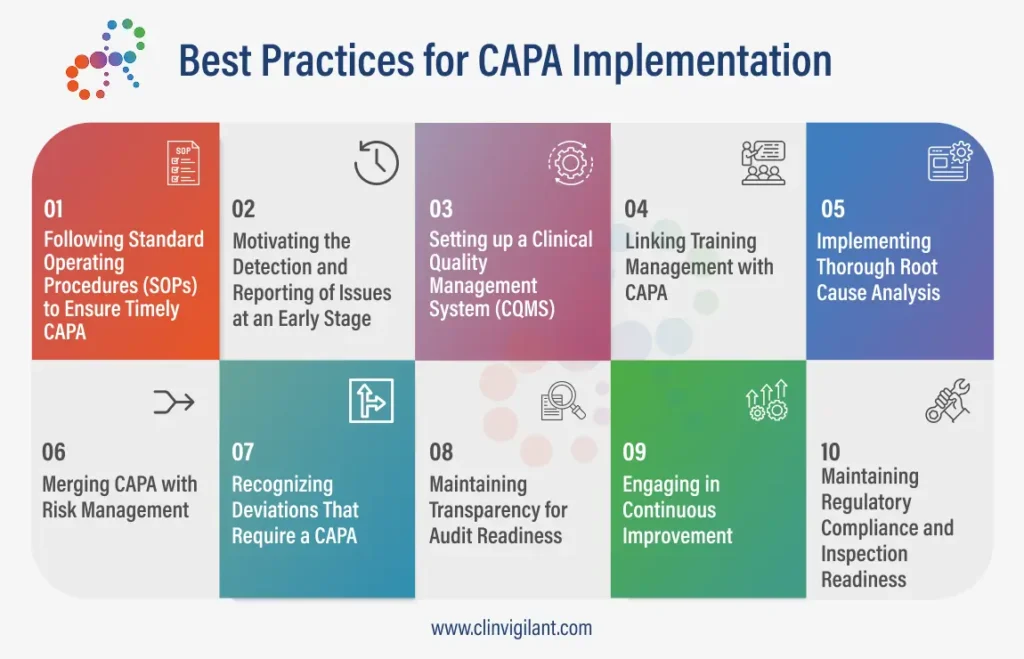
1. Following Standard Operating Procedures (SOPs) to Ensure Timely CAPA
One of the most important things in CAPA management is timeliness. A company should make sure that all CAPAs follow Standard Operating Procedures (SOPs) and are closed within the set timeframes to keep up with the standards and avoid any regulatory escalations.
2. Motivating the Detection and Reporting of Issues at an Early Stage
An effective reporting culture is a main factor in preventing problem situations from spiraling out of control. A company should support open communication; thus, the staff and the investigators are more than willing to report the deviations as they do not expect any negative consequences.
3. Setting up a Clinical Quality Management System (CQMS)
CAPA should be one of the components of the firm’s CQMS, which guarantees the cooperation of the operational quality, documentation, and supervision. The system provides for a smooth accountability transition from the point of deviation to the solution.
4. Linking Training Management with CAPA
By integrating its CAPA system with training management, a company ensures that employees responsible for a deviation are targeted for re-training. This strategy lowers the rate of recurrence, and regulatory compliance receives a boost.
5. Implementing Thorough Root Cause Analysis
An RCA that is data-driven is used by the company (CRO) to correctly identify the root causes of the problems. The company does this by associating deviations with gaps in processes, technology limitations, or human factors, therefore coming up with correct solutions.
6. Merging CAPA with Risk Management
The risk-based CAPA ensures that the preventive steps will be in line with the ICH Q9 principles. Linking CAPA to Risk Management Plans (RMPs), a company gives priority to those quality attributes that are most likely to affect the safety of the subjects.
7. Recognizing Deviations That Require a CAPA
Not all deviations require a CAPA. A company should employ risk categorization to decide when a CAPA is to be initiated and ensures that the corrective action is in line with the severity and frequency of the problem.
8. Maintaining Transparency for Audit Readiness
The CAPA documentation scheme at company should be an exemplar of transparency and audit readiness. Each file has the components of root cause analysis actions taken, responsible persons, and effectiveness checks, which make it very easy to respond to the auditors during the inspection.
9. Engaging in Continuous Improvement
The company should treat CAPA as a vehicle for continuous improvement. The mistakes learned from every CAPA are used as fuel for the upcoming SOP changes, training improvements, and risk mitigation strategies.
10. Maintaining Regulatory Compliance and Inspection Readiness
A company should remain confident of the robustness of its CAPA system in the face of worldwide audits and regulatory inspections by ensuring that it is always in line with FDA, EMA, and ICH-GCP guidelines.
To be in line with international standards, companies needs the the CAPA operations in harmony with major regulatory frameworks and quality standards.

FDA (U.S.):
Regulation: 21 CFR Part 820.100 specifies CAPA requirements for medical devices and clinical research.
Expectation: The Institute of Technology requires CAPA to be identified, documented, and systematically verified for effectiveness.

EMA (European Medicines Agency):
Guideline: EudraLex Volume 4, Annex 11 specifies CAPA as a part of computerized systems integration.
Expectation: Production of documented evidence to support root cause analysis and preventive action plans.

ISO 9001 / Quality Management Principles:
Focus: Emphasizes the need for continuous improvement, documentation control, and corrective mechanisms.
Application: Clinvigilant has aligned its CAPA and CQMS with ISO 9001 standards to ensure quality consistency across projects.

ICH-GCP (E6 R2):
Guideline: Introduces a risk-based approach to quality management and continual process enhancement.
An effective CAPA system provides direct support to:
For every CRO, CAPA is not just a compliance requirement – it is a strategic quality pillar that helps clinical development to be ethical, efficient, and always ready for inspections.
The Corrective Action and Preventive Action (CAPA) turns a CRO’s challenges into opportunities for improvement. Every CRO follows CAPA in each clinical operation phase – from trial design to data submission.
The use of CAPA in clinical trials is about creating trust – trust of regulators, investigators, and patients, who are the main beneficiaries of research advances.
By adopting CAPA best practices like issue detection at an early stage, root cause analysis, and risk management integration, Clinvigilant Research not only meets the regulatory requirements but also ensures the organization’s quality keeps getting better.

Clinvigilant Research is a global full-service CRO (Contract Research Organization) dedicated to advancing clinical development with scientific precision and patient-centric solutions. With our end-to-end CRO services sponsors can accelerate time-to-market while maintaining the highest standards of quality and compliance. With global reach and deep therapeutic expertise, we partners with sponsors to bring safe, effective, and innovative therapies to patients worldwide.

| Cookie | Duration | Description |
|---|---|---|
| _wpfuuid | 11 years | This cookie is used by the WPForms WordPress plugin. The cookie is used to allows the paid version of the plugin to connect entries by the same user and is used for some additional features like the Form Abandonment addon. |
| cookielawinfo-checkbox-advertisement | 1 year | Set by the GDPR Cookie Consent plugin, this cookie is used to record the user consent for the cookies in the "Advertisement" category . |
| cookielawinfo-checkbox-analytics | 11 months | This cookie is set by GDPR Cookie Consent plugin. The cookie is used to store the user consent for the cookies in the category "Analytics". |
| cookielawinfo-checkbox-functional | 11 months | The cookie is set by GDPR cookie consent to record the user consent for the cookies in the category "Functional". |
| cookielawinfo-checkbox-necessary | 11 months | This cookie is set by GDPR Cookie Consent plugin. The cookies is used to store the user consent for the cookies in the category "Necessary". |
| cookielawinfo-checkbox-others | 11 months | This cookie is set by GDPR Cookie Consent plugin. The cookie is used to store the user consent for the cookies in the category "Other. |
| cookielawinfo-checkbox-performance | 11 months | This cookie is set by GDPR Cookie Consent plugin. The cookie is used to store the user consent for the cookies in the category "Performance". |
| CookieLawInfoConsent | 1 year | Records the default button state of the corresponding category & the status of CCPA. It works only in coordination with the primary cookie. |
| elementor | never | This cookie is used by the website's WordPress theme. It allows the website owner to implement or change the website's content in real-time. |
| viewed_cookie_policy | 11 months | The cookie is set by the GDPR Cookie Consent plugin and is used to store whether or not user has consented to the use of cookies. It does not store any personal data. |
| Cookie | Duration | Description |
|---|---|---|
| GetLocalTimeZone | session | No description |