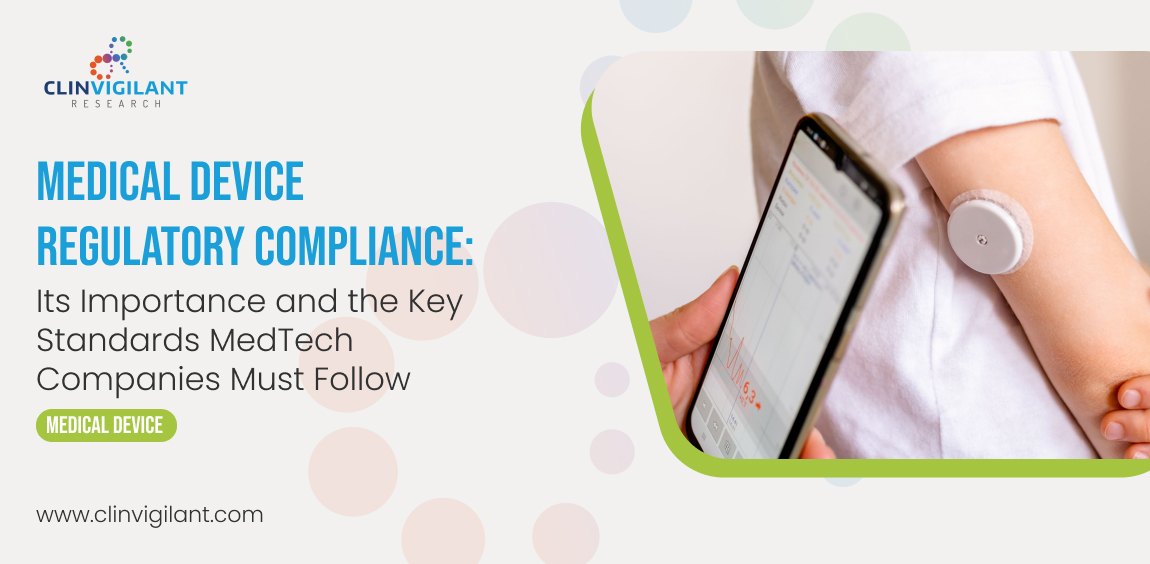
Grasping the concept of medical device regulations, implementing the correct quality frameworks, and being perpetually ready with the documentation are definitely the key stages of constructing devices that are safe, effective, and ready for the market.
This article sheds light on what Medical Device Regulatory Compliance is, why it is necessary, and the different international standards that companies have to comply with.
Medical device regulatory compliance is a process of verifying that a medical device is in line with the legal, technical, and safety standards set by the regulatory bodies in the markets where it is available. These rules are about:
The scope of the compliance is the entire product lifecycle-from idea and prototyping to production, distribution, and post-market monitoring.
To put it simply, medical device compliance standards are the requirements that make sure every device that is brought to the market is safe, effective, and can be traced, and is made in the same way consistently.
Compliance in the medical device industry is more than a legal requirement; it ensures the safety, quality, and effectiveness of medical devices. By following regulatory standards, companies can protect patient health, build trust, maintain market credibility, and support long-term business growth. Below are the key reasons why compliance matters.
Patient safety is the primary reason for the existence of all medical device regulatory requirements worldwide.
2. Facilitates Market Access and Regulatory Approval
It is mandatory for any device to follow the respective medical device regulations in the US, EU, India, or any other area before being marketed legally. For instance:
Hence, compliance acts as the necessary entrance to business achievements and is not a matter of choice.
Failure to comply with regulations may lead to:
One of the advantages of MedTech companies is that they are able to create strong compliance processes with which they gain the trust of patients, clinicians, and regulators.
Below are the key regional and global standards for conformity, which serve as the main pillars for companies desiring to enter the international market.

This is one of the most recognized medical device regulatory requirements. It provides the framework for:
This regulation is the authority for:
Companies might require the following to promote a device in the US:

MedTech companies that want to launch their products in the EU market have to conform to Regulation EU 2017/745 or the Medical Device Regulation (MDR), as it is commonly known. This is one of the strictest healthcare regulations worldwide.
Main requirements are:
CE marking is the only time allowed if full MDR compliance has been verified.
Essential compliance measures comprise:
ISO 13485 – Quality Management System for Medical Devices
The quality system standard has been set by the medical device industry. It has a wide scope, and the details are covered in the standard, including:
Most regulators demand that a company be certified to ISO 13485.
This standard describes the risk management process that is aligned with a device’s lifecycle. It supports companies in making sure that:
Essential to all technology and AI-based gadgets. Consists of:
Essential to all technology and AI-based gadgets.
Consists of:
IEC 62366 – Usability Engineering for Medical Devices
Confirms that devices have been made with the user’s safety and straightforward operation as the main priority.
The standard primarily deals with the identification of possible use-related hazards, the assessment of user interactions, and the design of such intuitive interfaces that minimize errors.
In adhering to the requirements of the IEC 62366, manufacturers make their devices more effective, improving patient outcomes, and at the same time, they are in line with the regulatory requirements of the global markets.
Clinvigilant Research is a reliable collaborator that raises MedTech companies’ efficiency levels when introducing their innovative devices worldwide.
1. End-to-End Regulatory Expertise
We assist the whole way of the product chain from innovation to clinical trials and submission, ensuring compliance with standards and norms:
2. Full CRO Capabilities for MedTech Companies
As a full Contract Research Organization (CRO), Clinvigilant Research is geared up to provide the following services:
3. Faster Regulatory Approvals
We achieve this by making your documentation, risk management, and testing processes more efficient, thus giving you more time to concentrate on taking your product to the market.
Our crew is there to make sure that every technical file, clinical evaluation report, and risk assessment is up to date with the newest regulations—thereby lessening the probability of questions, delays, or rejection by the authorities such as the FDA, EU Notified Bodies, or CDSCO.
Clinvigilant Research additionally makes it easy for your engineering, quality, and regulatory teams to communicate with each other, thus ensuring that the evidence is complete, accurate, and audit-ready. By means of our anticipatory strategy, we empower you to eradicate compliance gaps at the outset, thereby speeding up the review timelines and facilitating a smoother route to the global market.
4. Technology-Enabled Compliance
We deploy technology-driven solutions for:
This not only allows for auditing but also guarantees that all transactions are traceable and in line with the global standards.
It includes legal, technical, and safety requirements that are met through medical device regulatory compliance, which in turn are necessary to ensure that medical devices remain safe, effective, and get approved for market distribution.
The main thing that compliance does is to make patient safety the priority, as well as to ensure product quality, allow for market access, and protect manufacturers from legal and financial risks.
These are mainly 21 CFR Part 820 (QSR), 21 CFR Part 11, and 510(k), PMA, and De Novo Regulatory pathways.
They include ISO 13485, ISO 14971, IEC 60601, IEC 62304, and IEC 62366.
We are the ones MedTech companies would want to work with if they are looking for a partner who offers full regulatory, clinical, and quality support and thus enabling them to achieve global compliance faster.

Clinvigilant Research is a global full-service CRO (Contract Research Organization) dedicated to advancing clinical development with scientific precision and patient-centric solutions. With our end-to-end CRO services sponsors can accelerate time-to-market while maintaining the highest standards of quality and compliance. With global reach and deep therapeutic expertise, we partners with sponsors to bring safe, effective, and innovative therapies to patients worldwide.

We use cookies to improve your experience on our site. By using our site, you consent to cookies.
Manage your cookie preferences below:
Essential cookies enable basic functions and are necessary for the proper function of the website.
Google's current Sign in with Google client library. It renders the Google sign-in button, or the One Tap prompt, so visitors can log in to your site with their Google account. It replaces the older Google Sign-In platform library.
Service URL: policies.google.com (opens in a new window)
Google Tag Manager simplifies the management of marketing tags on your website without code changes.
Statistics cookies collect information anonymously. This information helps us understand how visitors use our website.
Google Analytics is a powerful tool that tracks and analyzes website traffic for informed marketing decisions.
Service URL: policies.google.com (opens in a new window)
Google reCAPTCHA helps protect websites from spam and abuse by verifying user interactions through challenges.
Marketing cookies are used to follow visitors to websites. The intention is to show ads that are relevant and engaging to the individual user.
AddToAny provides share and follow buttons that let visitors post your pages to social networks, messaging apps, and bookmarking services.
Service URL: www.addtoany.com (opens in a new window)